
Total Cost of Ownership Comparison for Latin America Supermarkets
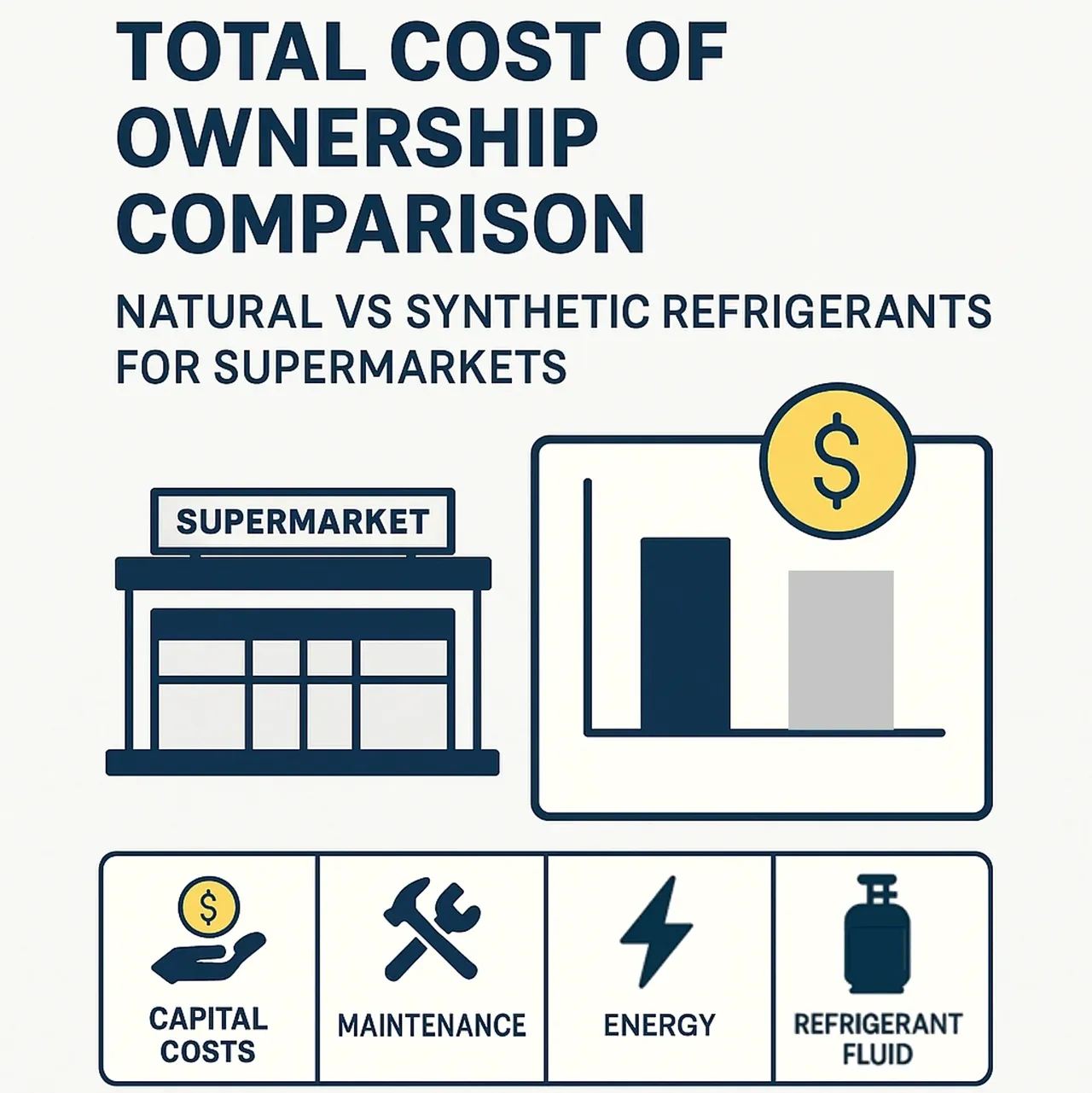
Total Cost of Ownership Comparison for Latin America Supermarkets
This analysis compares the 10-year total cost of ownership (TCO) for small, medium, and large Latin American supermarkets using four refrigerant options: natural CO₂ (R-744), propane (R-290), and synthetic HFO blends R-449A and R-454C. It includes all costs in USD—capital, installation, energy, refrigerant, maintenance, and disposal—while accounting for regional factors like energy prices, regulations, and incentives based on current data.
Supermarket Formats
Three supermarket sizes are considered in this analysis: a small supermarket (approximately 300 m² and 100 refrigeration tons), a medium store (approximately 1,000 m² and 300 tons), and a large store (approximately 2,000 m² and 600 tons). For each category, equipment is assumed to be appropriately sized for the respective load.
System architectures
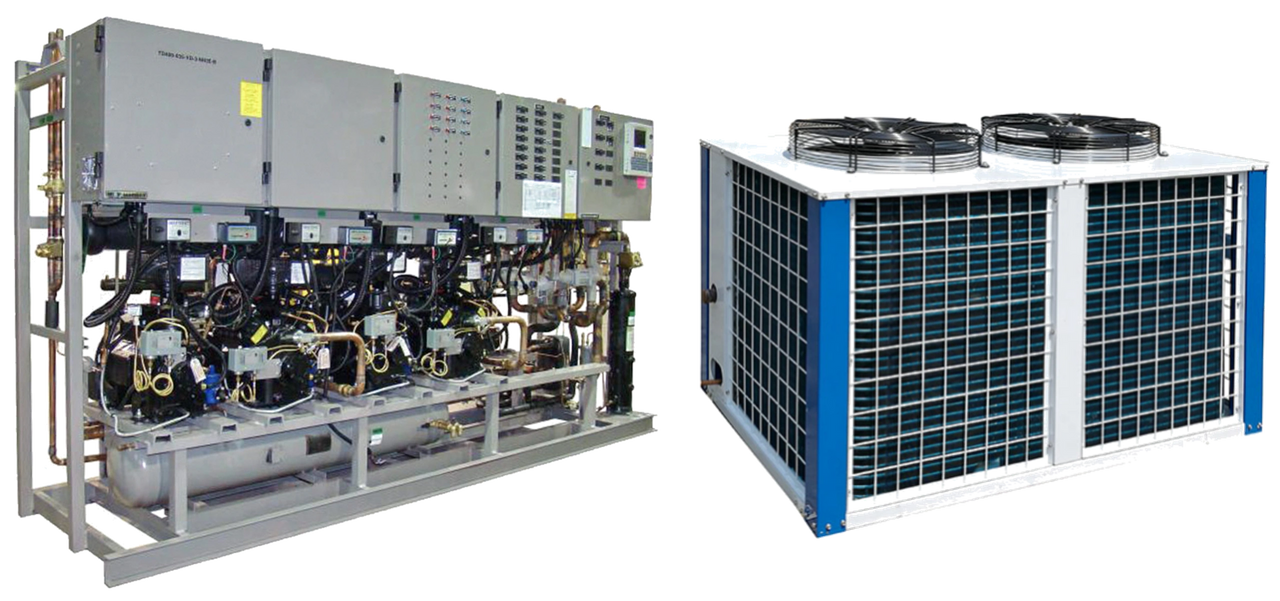
R-449A and R-454C systems utilize direct-expansion (DX) centralized and distributed system architecture configurations, like contemporary replacements for R404A/R507.
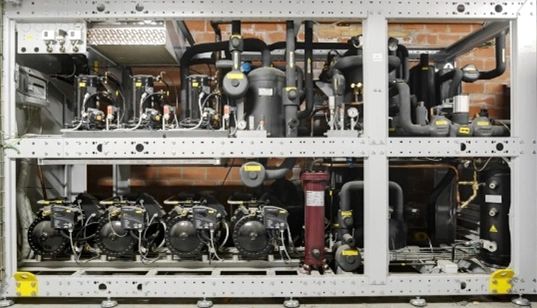
CO₂ systems are evaluated in transcritical booster systems and/or subcritical cascade configurations.
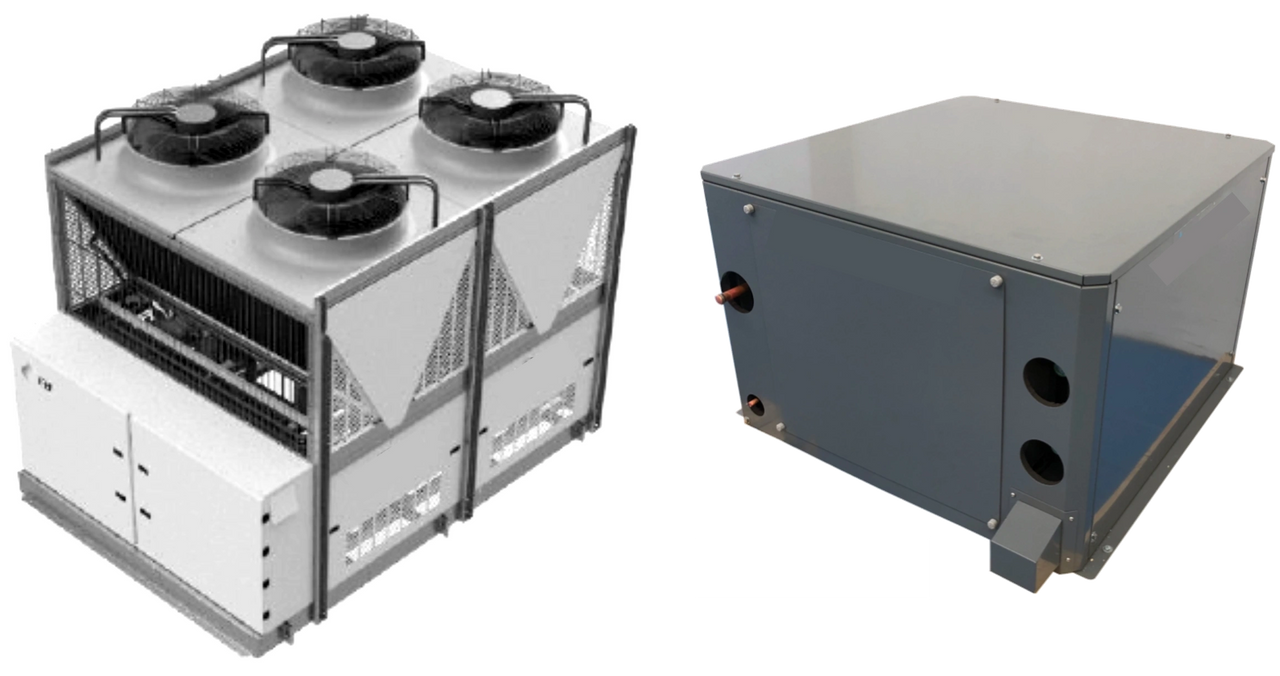
For R‑290, medium and low-temperature loads employ propane glycol chillers and CO₂ cascade system.
Capital & Installation Costs
The synthetic HFO R‑449A system (GWP ≈1,400) is used as our reference point for capital costs. In operational settings, R‑449A/448A rack costs are comparable to those of legacy R404A/R507 systems. A2L refrigerants (R‑454C) generally necessitate new equipment—including risk mitigation components and leak detectors—resulting in an estimated capital expenditure approximately 10% higher than that of R‑449A.
CO₂ systems have traditionally incurred greater expenses, with equipment costs exhibiting a 15–25% premium compared to HFC racks. However, industry feedback indicates that smaller-diameter piping and more compact racks can lower labor costs, reducing installation labor by 10–12% relative to HFC systems. As a result, the total installed cost of CO₂ racks is now only about 5 – 10% higher than synthetic systems.
Propane (R‑290) racks, typically designed as small chillers with glycol loops, also require additional safety features; accordingly, we estimate their capital expenditure to be roughly 10% higher than R‑449A.
In summary, for equipment and installation, we apply relative factors (R-449A=1.00; R-454C≈1.10; R-744≈1.10; R-290≈1.10), which are then multiplied by the baseline costs outlined in Table 1.
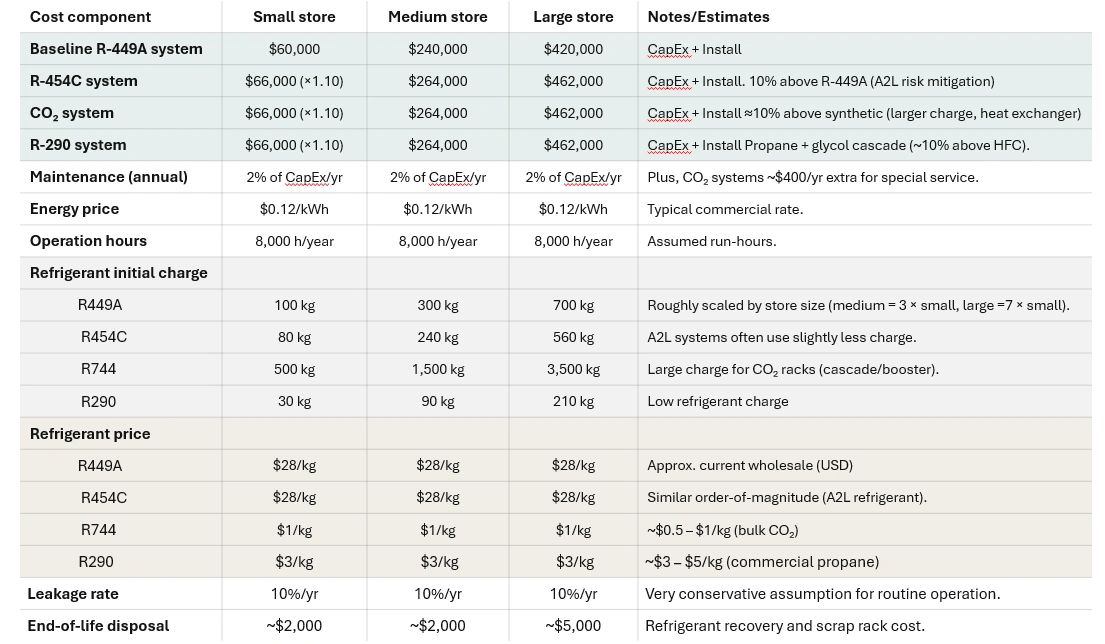
Note: All monetary values are presented in USD. Capital expenditures for small store formats are provided for illustration purposes; actual costs will vary depending on store size.
Energy Consumption and Operating Costs
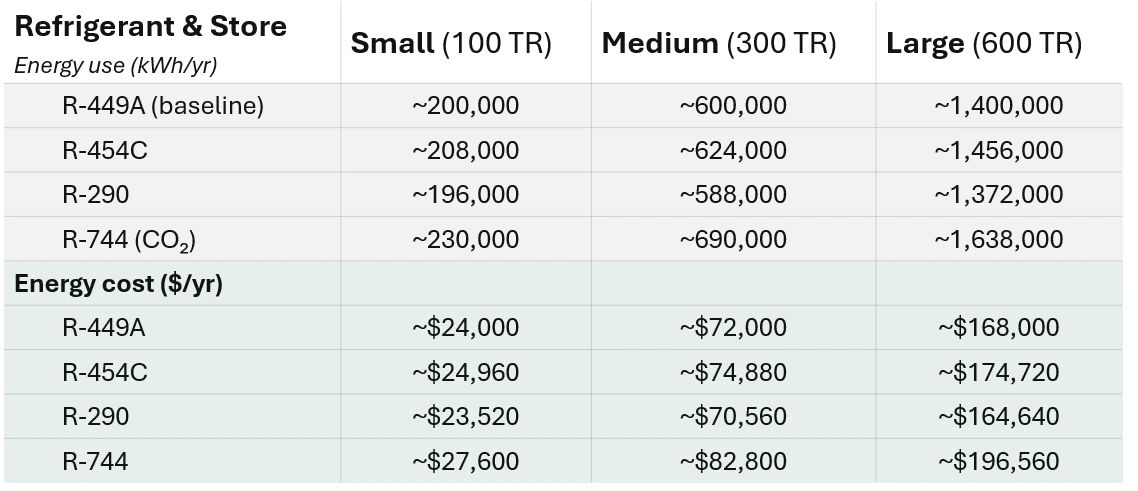
Energy consumption (kWh) represents the most significant operating cost. Refrigerant performance varies while CO₂ has minimal global warming potential (GWP), its coefficient of performance (COP) is influenced by both climate and system configuration. Recent analyses indicate that R‑454C and R‑449A systems can substantially outperform transcritical CO₂ systems under high-temperature conditions; simulations of retail refrigeration indicate seasonal COP improvements of approximately 12% and 17% for R‑454C and R‑449A over a CO₂ booster system, respectively. Field results corroborate these findings; for example, a major UK supermarket reported a 34.5% reduction in annual energy consumption following a transition from transcritical CO₂ to R‑454A HFO. Additionally, retrofit applications demonstrate that R‑449A (Opteon™ XP40) can reduce energy use by roughly 8% compared to legacy R404A/R507 systems. Propane (R‑290) cascade systems in Brazil achieved moderate energy savings (~3.5%) relative to R134a rack systems. Conversely, transcritical CO₂ racks typically exhibit higher energy consumption in warm ambient conditions—estimated here at approximately 15–20% greater than R‑449A under comparable climate assumptions.
Using these relative efficiencies, we estimate annual energy (with 8,000 running hours) and 10‑year energy cost for each scenario (see Table 2). For example, a small store’s R‑449A rack might use ~200,000 kWh/yr (~$24,000/yr at $0.12/kWh), whereas the CO₂ system would use roughly 15% more (~$28,000/yr) and R‑454C a few percent above R‑449A. These translate into large cost differences over 10 years (see Table 3).
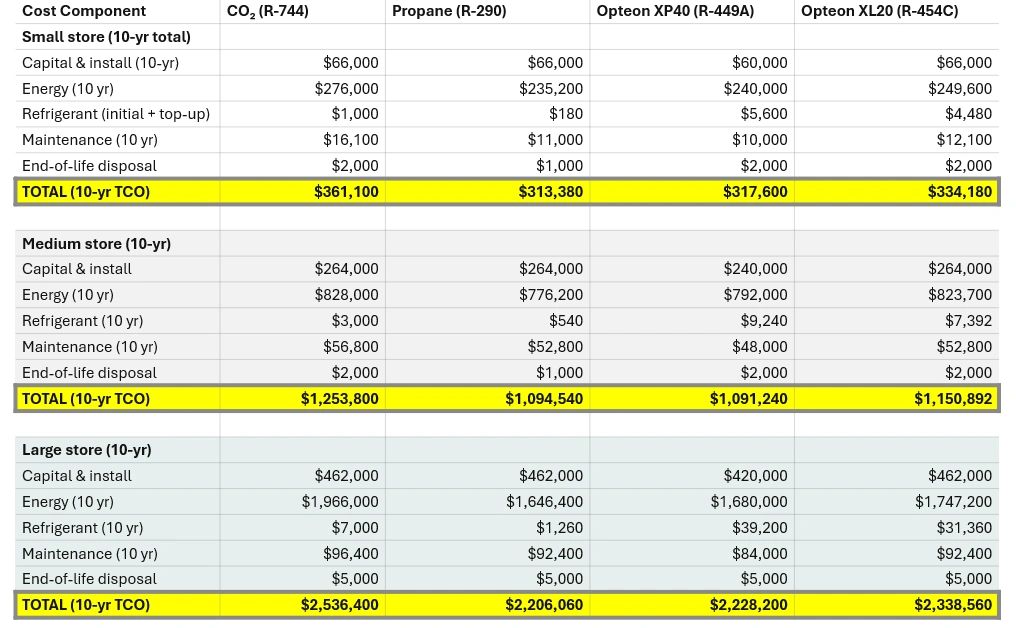
The data shows that, across different size categories, R‑290 and R‑449A systems have the lowest 10-year total cost of ownership (TCO), while CO₂ systems have the highest. In medium supermarkets, for example, the propane cascade system has a 10-year TCO of approximately $1.095M, like R‑449A at around $1.091M; both are lower than CO₂’s estimated $1.254M. R‑454C has an intermediate cost at about $1.151M.
This result is influenced primarily by two factors: (1) higher energy consumption of CO₂ systems in warm climates, despite reduced refrigerant costs, and (2) increased capital expenditures required for CO₂ racks. R‑290 systems demonstrate modest energy savings and lower refrigerant costs, offsetting somewhat greater capital expenditure.
R‑449A is associated with established performance and moderate expenses. R‑454C (A2L) provides low refrigerant global warming potential but, under these assumptions, results in a slight increase in capital expenditure and marginally higher energy usage, leading to a moderate TCO.
These results align with earlier studies indicating that R‑454A/C can achieve notable emissions reductions while maintaining competitive costs, as well as analyses suggesting that R‑449A may recover its costs through energy savings over several years.
Conclusions
Analysis indicates that, in the current context of Latin America, propane and HFO systems typically present the lowest 10-year costs for supermarket refrigeration, while transcritical CO₂ systems are generally associated with higher expenses, primarily due to increased capital expenditure and energy consumption in warmer climates. These outcomes are dependent on assumed energy prices and system specifications. Empirical data, such as a reported 34% reduction in energy use when transitioning CO₂ to R‑454A, or rapid payback periods from R‑449A retrofits, indicate that lower-GWP HFOs may be cost-competitive options. Natural refrigerants including R‑744 and R‑290 have very low climate impact and refrigerant costs, though their adoption in Latin America may require consideration of higher system costs and more stringent safety regulations. The implementation of incentives or stricter HFC phase-down measures by policymakers, as seen in Europe and North America, could influence these dynamics further.
Sources
Have We Reached the Tipping Point for CO2 Refrigeration Systems? | Henderson Engineers
R744 Refrigerant Gas for Auto Refrigeration Carbon Dioxide Refrigerant CO2 – R744 and CO2
Refrigerant r290 price Manufacturers & Suppliers, China refrigerant r290 price Manufacturers Price
Performance Assessment of R-454C, R-449A, and R-744 in Food Retail Refrigeration Systems
Supermarket | Contracting Business
R449A retrofit brings 8% energy savings – Cooling Post
Brazilian Supermarket Chain Sees Energy Savings with Remote R290 System
Second Brazilian supermarket invests in CO2 refrigeration (Internacional) | Clipping | ABRAS
https://atmosphere.cool/wp-content/uploads/2025/02/2024_ATMO_Marketreport-compressed.pdf
Category: Business & Strategy